
Does your child sleep with their mouth open?
It’s more common than you think, and more treatable than most parents realize.
You noticed something. That instinct matters.
Maybe you’ve been told it’s just a phase. Or to keep an eye on it. Or that they’ll grow out of it. And maybe they will. But mouth breathing that persists past early childhood tends to affect how the face grows, how well the brain rests, how the jaw develops, and how easy or hard the orthodontic road becomes.
If you’re here because something felt off and you wanted answers, you’re in the right place. Excel Airway specializes in airway health for children and adults, through a non-invasive, evidence-based therapy that addresses the root cause.

Mouth breathing isn’t just a habit, it’s a signal
When a child breathes through their mouth consistently — especially during sleep — it usually means the airway isn’t functioning the way it was designed to. The muscles of the tongue, lips, and throat may not have the tone or resting posture they need to keep the airway open nasally. That can come from tongue tie, structural factors, early habits, or a combination.
The nasal passages are built to filter, warm, and humidify incoming air. They also produce nitric oxide, which improves oxygen delivery and supports immune function. Mouth breathing bypasses all of that. And in children specifically, the effects compound over time:
- The palate narrows, because nasal breathing creates gentle pressure that widens it. Mouth breathing removes that pressure.
- The jaw develops differently, often longer and narrower, which affects how the face grows.
- Teeth crowd earlier and more severely, often before an orthodontist is ever involved.
- Sleep quality suffers, which affects focus, mood, and behavior during the day.
The earlier you address a mouth breathing pattern, the gentler and more effective the path forward can be. Most parents who come in wish they’d come sooner — not because they waited too long, but because they didn’t know this was something that could be addressed at all.

Signs a myofunctional evaluation might help your child
These symptoms could share a common thread. If your child experiences any of the following, it’s worth a conversation.
- Sleeping with mouth open, consistently
- Snoring, even lightly
- Restless sleep, frequent waking, or waking unrefreshed
- Tongue tie (diagnosed or suspected, before or after release)
- Speech delays, lisping, or articulation concerns
- Crowded, crooked, or erupting teeth in unusual patterns
- Narrow palate or high-arched roof of the mouth
- Bedwetting beyond typical developmental age
- Difficulty focusing, hyperactivity, or behavior concerns linked to poor sleep
What myofunctional therapy actually does
Myofunctional therapy is a structured exercise program that retrains the muscles of the mouth, tongue, and throat — the ones that control how your child breathes, swallows, and holds their tongue at rest. When those muscles develop proper tone and posture, nasal breathing becomes the default. The airway stays open and the palate gets the pressure it needs to develop properly.
The exercises are simple, non-invasive, and designed for children. Most kids practice for about 10–15 minutes a day at home, with regular check-ins to assess progress.
Four things that make the program work:
1. Qualified Team
Dr. Tracy Davis is a general dentist with an airway-focused approach, integrating airway health into comprehensive dental care. Jenna Lyons, RDH, is our certified myofunctional therapist, providing myofunctional therapy for appropriate patients.
2. Personalized Program
Your child’s program is built from their evaluation. Not a template.
3. In-Office or Virtual
The initial evaluation is in person. Follow-up sessions can be virtual, which makes weekly check-ins a lot more manageable for busy families.
4. Coordinated Care
If your child has a dentist, orthodontist, or pediatrician already involved, we communicate with them. You don’t have to be the relay between providers.
What to expect
Every child starts with an evaluation and ends with a program built around their specific pattern, age, and goals.
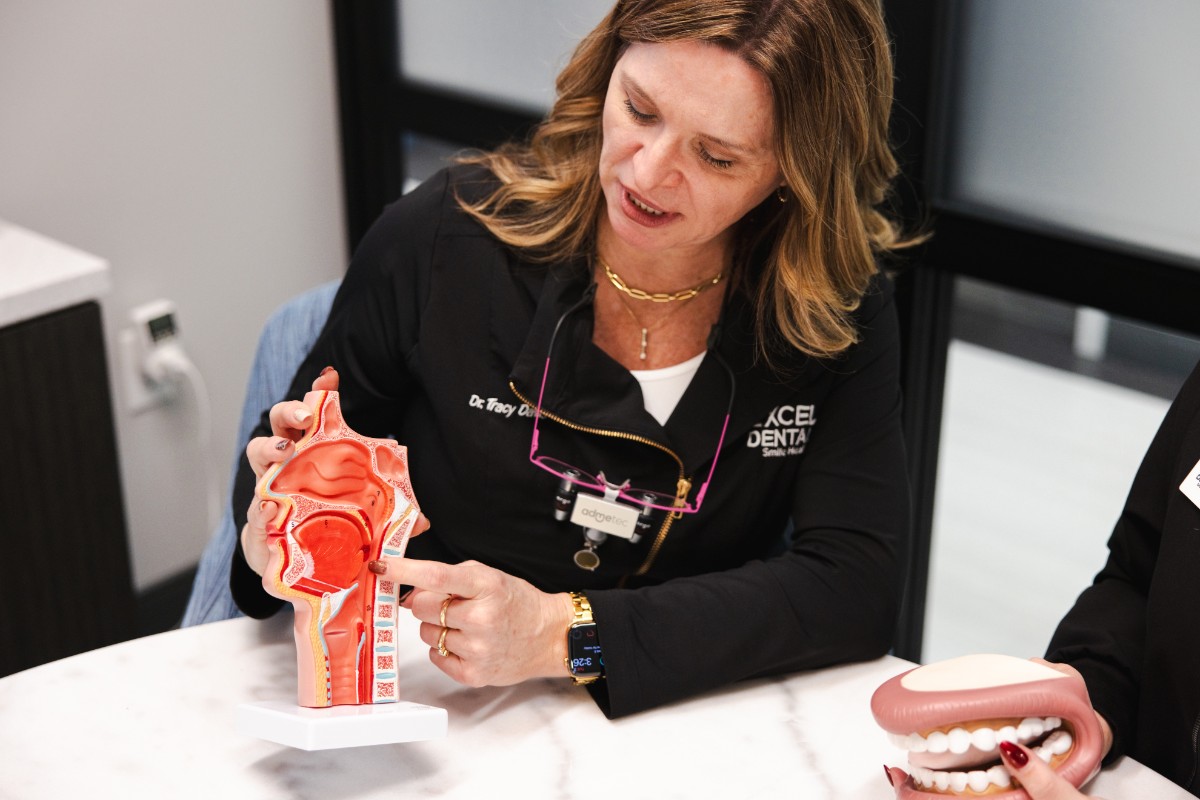
1. Initial evaluation in person
A thorough look at your child’s breathing patterns, tongue posture, swallowing function, and oral structure. We’ll go through their history, figure out what’s contributing, and talk through whether myofunctional therapy is the right fit. This is also a good time to ask every question you’ve been sitting on.
2. A program built for your child
Based on the evaluation, our therapists build a customized exercise plan and walk you through the first exercises before you leave. Daily practice takes about 10–15 minutes.
3. Active Therapy — Months 1 through 3
Regular sessions every one to two weeks to advance the program and check in on progress. In-office or virtual, your choice after the initial visit.
4. Refinement & Completion — Months 3 through 6
As the muscle patterns improve, sessions focus on reinforcing the new habits. Most programs wrap up within four to six months. We provide a summary to any involved providers and a maintenance plan to protect the results.
Meet our myofunctional therapists
Jenna Lyons
Jenna is a qualified myofunctional therapist with training from well known MyoMentor, serving children and adults throughout the Ozarks area. She focuses on airway health, post-frenectomy therapy, and sleep disordered breathing, using a comprehensive, patient-centered approach to support long-term functional outcomes. Jenna is passionate about helping patients improve breathing, oral function, and overall quality of life through individualized care.
Jenna believes every patient who walks in with a breathing problem deserves a provider who asks why — not just what.
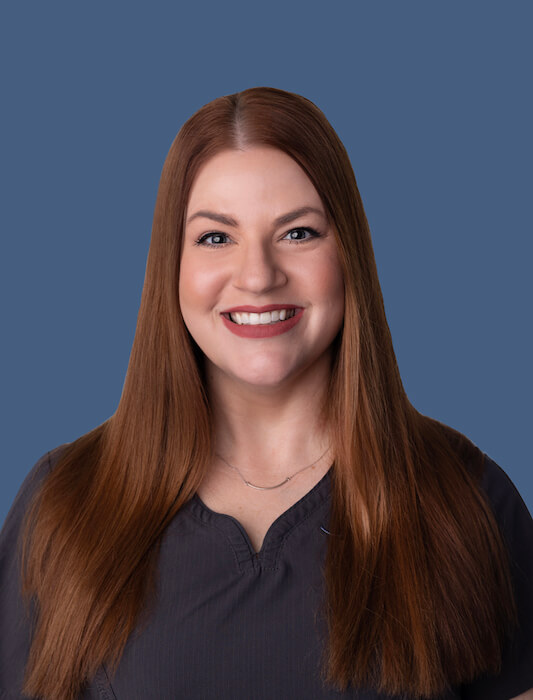
Dr. Tracy Davis
Dr. Davis is dedicated to helping patients breathe, sleep, and live healthier through personalized airway-focused dental care. She is passionate about identifying underlying airway concerns that may impact sleep, overall health, growth, and quality of life. In alignment with the American Dental Association recommendation that dentists screen patients for possible airway-related issues, Dr. Davis believes comprehensive dental care extends far beyond teeth alone. She loves building lifelong relationships with patients and believes dentistry is a unique blend of science, health, and artistry. A top graduate of the University of Missouri–Kansas City School of Dentistry and a Kois Center Graduate, Dr. Davis brings advanced training, clinical excellence, and a compassionate approach to every patient experience
Dr. Davis is committed to helping patients breathe better, sleep healthier, and feel their best through compassionate, personalized care built on trust and lasting relationships.

Questions we hear from parents
Will my child grow out of it on their own?
Some habits do resolve. But mouth breathing and tongue posture patterns that persist past early childhood tend to become structural. The palate narrows, the jaw develops differently, and by the time crowded teeth appear, the easiest window has passed. A brief evaluation can tell you whether your child’s pattern is self-resolving or worth addressing now.
How young is too young to start?
It depends on the child and the concern. We work with children as young as four or five for foundational habits, and older children for more complex programs. We’ll let you know at the evaluation whether the timing is right or whether a “watch and check back” approach makes more sense.
Is this connected to my child’s tongue tie?
Very likely, yes. Tongue tie restricts tongue movement and often prevents proper resting posture, which means the mouth stays open and the airway doesn’t get the muscular support it needs. Whether the tie has been released or not, myofunctional therapy addresses the muscular patterns that often accompany it.
What if the tongue tie was already released?
The frenectomy removes the restriction. But the muscles that compensated around it still have their old habits. Without retraining, the tongue often goes back to the same dysfunctional patterns. Myofunctional therapy is what makes the release outcome last.
How long does the program take?
Most programs run four to six months, with daily exercises of about 10–15 minutes. Your child will meet with us every one to two weeks. Sessions are available in-office or virtually after the initial in-person evaluation.
Is it covered by insurance?
Coverage varies by plan. Some medical insurance policies cover myofunctional therapy when it’s associated with a diagnosis like sleep-disordered breathing or tongue tie. We can provide documentation for you to submit to your insurance company to support your reimbursement claims. However, please note that we do not file insurance claims for myofunctional therapy. Contact us before the first appointment and we’ll help you figure out what may apply.
Ready to get started?
Call (417) 581-3600